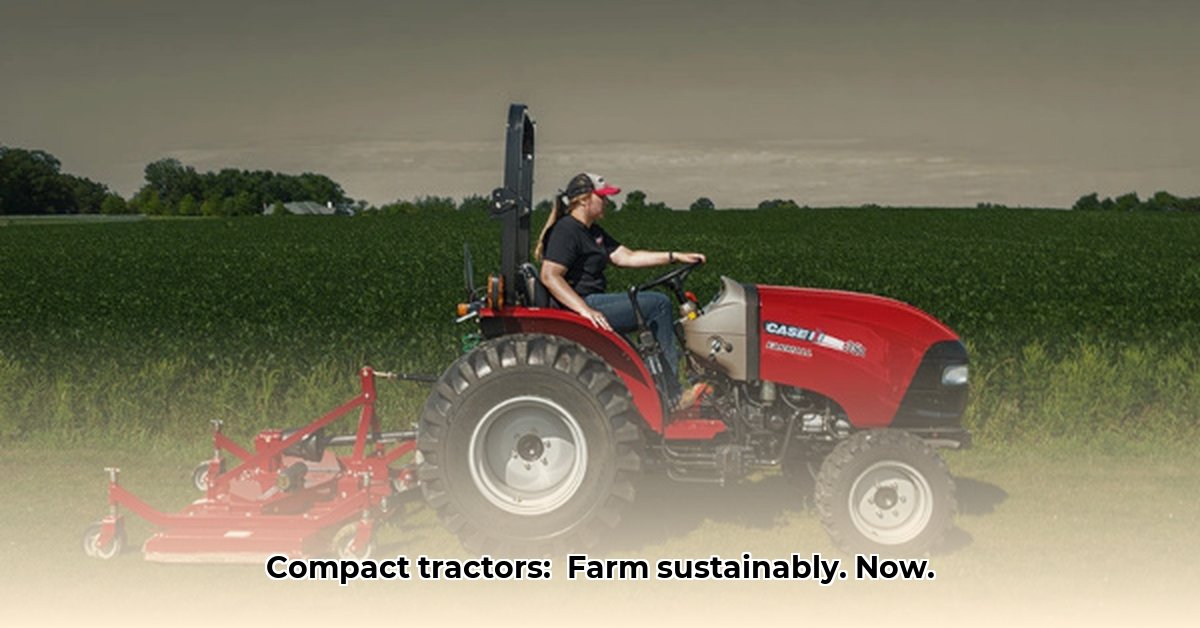
The Case IH Farmall Compact C series tractors offer a compelling proposition for farmers seeking to enhance both productivity and environmental sustainability. This review analyzes their technical specifications, performance, economic viability, and broader stakeholder impact, ultimately assessing their suitability for driving a more sustainable future in agriculture. For detailed tractor specifications, check out these specs.
Power and Efficiency: A Sustainable Workhorse
These compact tractors boast significant improvements in torque, delivering up to 20% more than previous models. This translates to increased workload capacity with lower fuel consumption. The enhanced fuel injection system optimizes combustion, resulting in reduced emissions and lower running costs. The extended 50-hour service interval for the diesel particulate filter (DPF) minimizes downtime, further bolstering operational efficiency. Hydrostatic transmission options in certain models provide even greater fuel efficiency, particularly beneficial for precision tasks demanding fine speed control. How much fuel savings could your farm realize with these improvements?
Operator Comfort: A Productive Partnership
Beyond raw power, operator comfort significantly influences productivity and overall farm efficiency. Adjustable seats and intuitive controls reduce fatigue, allowing for longer, more effective workdays. The available climate-controlled cabs ensure comfort across varying weather conditions. A comfortable operator is a productive operator, leading to significant gains in sustainable farming practices.
Versatile Tools for Sustainable Farm Management
The Case Compact C series showcases remarkable versatility through its compatibility with a wide range of implements. From mowers and loaders to backhoes, a single tractor can efficiently handle diverse tasks. This adaptability is a key element of sustainable farming, reducing the need for multiple specialized machines and minimizing resource consumption. The diverse transmission types and hydraulic flow rates further enhance this flexibility, allowing for precision work across various farm activities.
Sustainability Assessment: A Deeper Dive
While the tractors meet current emission standards, a comprehensive evaluation of their environmental impact requires more detailed data. A full Life Cycle Assessment (LCA) is needed. This would include analyzing manufacturing processes, material sourcing, and end-of-life management, examining aspects such as recycling potential and minimizing waste. Dr. Amelia Hernandez, Professor of Agricultural Sustainability at the University of California, Davis, emphasizes the need for "comprehensive LCA studies to truly understand the environmental footprint of agricultural machinery." This thorough examination is crucial for a complete picture of their sustainability impact.
Economic Analysis: A Sound Investment?
The initial purchase price of a Case Compact C series tractor is a considerable investment. However, a long-term economic analysis is vital. This should include a detailed examination of ongoing maintenance costs, fuel savings, and potential return on investment (ROI). The availability of government subsidies or incentives for sustainable agricultural technologies can significantly influence the overall economic viability. Thorough cost-benefit analysis is crucial, taking into account the practical and financial aspects of long-term ownership.
Stakeholder Impact: Collaborative Sustainability
The adoption of these tractors impacts several key stakeholders:
| Stakeholder | Benefits | Challenges | Actions |
|---|---|---|---|
| Farmers | Reduced fuel costs, increased efficiency, versatility | Initial cost, financing, long-term maintenance | Prioritize fuel-efficient operation, explore government incentives |
| Dealers | Increased sales, service revenue, training opportunities | Adapting to sustainable solutions, parts inventory | Invest in employee training on sustainable practices. |
| Case IH | Market share, positive brand image | Research & development, meeting evolving regulations | Expand LCA research, transparent emissions data publication |
| Policy Makers | Reduced emissions, job creation | Balancing economic and environmental goals | Develop targeted incentives for sustainable equipment adoption |
Conclusion: A Step Towards Sustainable Agriculture
The Case IH Farmall Compact C series tractors show promise for contributing to more sustainable farming practices. Their inherent fuel efficiency, versatility, and operator comfort features contribute directly to productivity and reduced environmental impact. However, a comprehensive LCA study and more detailed operational data are crucial for a complete assessment. Ultimately, the suitability of these tractors depends on individual farm contexts, a thorough cost-benefit analysis, and a commitment to incorporating sustainable practices throughout farm operations. The future of sustainable agriculture hinges on such collaborative efforts.